Archive for April, 2009

Inclusive language, part 2

April 30th 2009

The search for an alternate way to say “man hours” and “manhole covers” for an employee newsletter article (how about “work hours” and “sewer covers”?) got me looking again at the whole issue of gender neutral (or gender fair) language.

Some people scoff at even calling it an issue, but I notice that most of these scoffers are men.

Canada’s Department of Justice perhaps summarizes it best that “Gender neutrality is important when writing about people because it is more accurate — not to mention respectful — and is consistent with the values of equality recognized, for example, in the Canadian Charter of Rights and Freedoms.”

I found a comment in a handout from the Center for Communication Practices at Rensselaer that says gender fair language also “minimizes unnecessary concern about gender in your subject matter, allowing both you and your reader to focus on what people do rather than on which sex they happen to be.”

It’s not too hard to exchange “man” for a word that recognizes that people in a particular group are not all men. Common substitutions are firefighter vs. fireman; police officer vs. policeman; worker vs. workman; flight attendant vs. stewardess/steward; wait staff vs. waitress/waiter. Why not use the inclusive business executive instead of businessman, con artist instead of con man, camera operator instead of cameraman? And what’s wrong with adult-sized vs. man-sized, human vs. man?

Then there’s the whole he/she thing. Avoid any issues by:

  • Using the plural. Instead of “We have to accept our child with his strengths and weaknesses” use “We have to accept our children with their strengths and weaknesses.”
  • Rewriting the sentence without pronouns. Instead of “If the researcher is the principal investigator, he should place an asterisk after his name” rewrite to “Place an asterisk after the name of the principal investigator.”
  • Replacing the masculine pronoun with an article. Instead of “The consultant will summarize in his report” use “The consultant will summarize in the report.”

I’m less fond of these options:

  • Using a double pronoun, such as his or her, he or she, him/her, he/she.
  • Alternating using masculine and feminine. 
  • Using “they” as singular. “Every taxpayer shall file their tax return.”

There are lots of options out there. As writers, whether in memos and e-mail messages or articles and novels, it’s up to us to find them.

Cool promos

April 28th 2009

USB drives are useful. Mini highlighters are cute. There are magnets, keychains, stress balls, lanyards, mugs and sports bottles everywhere. But THESE are cool ways to promote your company (sadly, not available to Canadians):

*  Sharpie will personalize your pen — nothing hateful or obscene, please! — for $11.99 for six. Be inspired looking at samples done for a wedding, Valentine’s Day, a graduating class and more.

*  M&Ms can also be personalized with your name, company name, URL or very short message up to eight characters on each of two lines. You can try different things and see how it looks on the candy model. I could fit “Get It” on one line and “Write” on the next. You have to buy a minimum, such as 20 1.7-oz bags for $3.99 each or 20 1.6-oz silver tins for $4.25 each. Or get a bulk five-pound box for $130 and repackage in your own containers.

*  Lego figure as a business card. Only available to certain Lego employees, and not available to you or me, but that doesn’t mean I don’t want one!

Thanks to Andy Sernovitz for the link to the Sharpie site.

Feeling Twittery

April 23rd 2009

And there you have it - one of my pet peeves about Twitter. How every second word is turned into adaptations and variations of the word Twitter and the messages known as tweets. Your words go out into the Twitterverse or tweetstream. People are Tweeple or just Tweeps. The cool kids are the Twitterati.  And on and on. It’s enough to give you a Twitterache!

So what’s good about Twitter?

Dan Santow says the 140-character limit is a good exercise for anyone who thinks of themselves as a writer. “I’m becoming reacquainted with telegraphing information in a tight, focused way to grab readers’ attention. I’d forgotten how hard it is to write so few words but express so much.”

Jennifer Blanchard at Copyblogger suggests using Twitter makes you a better writer, by forcing you to be concise, use your vocabulary and improve your editing.”You have to know exactly what you want to say, and say it in as few words as possible.”

Shel Holtz says, “Far from a collection of short, standalone messages for the attention-challenged (as many see it), Twitter is frequently a gateway to more, deeper content” such as blog posts, breaking news, videos and photos.

And the bad?

Here are all these tweets pointing to interesting, useful, funny places you simply have to go and visit. It takes time, and I’ve noticed it also diverts bloggers from updating their blogs quite as often as they used to. (Ahem.)

Sometimz yr writing does not actually get bettr, becuz U edit this way 2 fit.

Globe and Mail columnist Margaret Wente laments that “There will soon be no one left with an attention span that exceeds 140 characters at a time.”

Her fellow Globe and Mail writer Ian Brown comments that “The absence of a central filter is what makes Twittering so pleasant and energetic and optimistic in the moment, and what makes it chaotic afterward.”

Well, with six million Twitterers in North America (six times as many as there were a year ago, apparently, although I can’t find where I got that statistic), there’s no denying Twitterville is a place you have to at least visit. You’ll find me on the beach under an umbrella @Sue_Horner.

Left hand, meet right hand

April 16th 2009

A card arrived yesterday the old fashioned way, in the mail with postage stamp and all. It was from my friends at the local Honda dealership. Since I have just closed the deal on a new car, I thought it might be a “thanks for buying our car” type of card. Silly me! It was a card inviting me to a “Private V.I.P. Customer Sale” with special pricing authorized for current Honda owners and their family members.

You could probably make the case that the card might have been put in the mail the day before I actually bought the car. But that doesn’t excuse the e-mail version that arrived today, four days after the big purchase, inviting me to the same V.I.P. sale. (This, by the way, said “RSVP by April 14″ and it arrived April 16.)

Talk about the left hand not knowing what the right hand is doing!

Today’s lesson, kiddies: Update your customer records as significant events occur. If you can set up your system to trigger a follow-up survey after a car is brought in for servicing, surely you can set it up to cancel messages about car sales to someone who has just bought a car from you.

P.S. I was glad to see that the “special discounts and financing” were the same as those offered in person. Who wants to be offered a sale price after you have already bought at a higher price?

Follow up to improve customer service

April 15th 2009

My recent car-hunting experience made me think. Why don’t companies follow up?

It all began when I brought my car in to the dealership for routine servicing. The service advisor called to say the mechanic had suggested some additional work, some of it fairly expensive. “Here’s the thing,” I answered. “I was going to buy a new car this year anyway, so I’m not prepared to spend that much.”

We agreed on the work that needed to be done now for safety reasons, and what could wait, and I went on my merry way.

I expected to hear from the sales department in a day or two, offering to set up a time to talk about what kind of car I wanted. But, as it turned out, the service department did not let the sales department know I  was interested in a new car.

Later, the dealership called to find out if I was satisfied with the work done on the car. I confessed I was waiting for a list I had requested of the mechanic’s recommendations. The caller promised to look into it. Later, when I was in the showroom looking at new cars, I dropped by the service area to ask about the list. More promises. Who knows? I might have had some of the work done, but by the time the list showed up (after I called), I had already bought a new car.

So, here’s what I’m taking away that can apply to my business as well as yours.

  1. If someone specifically asks for something you can provide, do it. If you can’t do so right away, make a note of it. Make sure others you work with are aware of the request.
  2. If your customer mentions a possible need, follow up. If you don’t have the item/service, can you connect the customer with someone who does? Check back later to see if you can help.
  3. If someone hands you a fat lead on a silver plate, jump on it!  You don’t have to be pushy about it, but why not call to say, “I hear you’re looking for…” and “Let me know if I can help”?

Avoid this gobbledygook

April 09th 2009

If ever there was encouragement to stay away from the overused word “unique” (not to mention “very unique”), here it is. At least 48,095 news releases used it in 2008.

David Meerman Scott’s analysis of 711,123 press releases distributed by North American companies last year displayed in alarming numbers just how “unique,” “world class,” “flexible” and “robust” the “new and improved” products were that these companies were “pleased to” announce. One of my real pet peeves, “leverage,” also made the top 10 list.

In Guy Kawasaki’s book, Reality Check, he suggests taking the opposite test. “See if your competition uses the antonyms of the adjectives that you use. If it doesn’t, your description is useless.” So there’s no point in claiming scalable, secure, fast and easy to use if other companies don’t admit their products are limited, full of leaks, slow and hard to use.

To check your own words out for weasel words and gobbledygook, check out the new Gobbledygook Grader Scott created with HubSpot.

Words that sent me to the dictionary

April 08th 2009

Some writers are known for sprinkling unusual words throughout their copy. It becomes their style or maybe a familiar quirk, but I do think it puts up a barrier between writer and reader. If you have to stop reading to go look up the word, doesn’t that break the flow and stop readers in their tracks? And let’s face it, how many readers are going to do that?

Of course, being a word nerd, I am among those who do look up words I don’t recognize. Here are some words that recently had me reaching for the dictionary:

Contumely:  Insulting, scornful or contemptuous language or treatment

Elision:  The omission of a vowel, consonant or syllable while pronouncing or writing something (like he’s or t’is)

Eidetic memory: Recalled with startling accuracy, clarity and vividness

Recondite:  Requiring special detailed knowledge to be understood

Steampunk (Not found in your ordinary dictionary but in the Urban Dictionary): A sub-genre of fantasy and speculative fiction that could be described as “what the past would look like if the future had happened sooner.”

Do you look up unusual words? What ones have you run across lately?

Eat for the cure ‘09

April 07th 2009

Inflammatory bowel disease (IBD) is three times more common in the Canadian population than multiple sclerosis or HIV, and about as common as Type 1 diabetes. But you don’t hear as much about it because, well, who wants to talk about something that happens to your bowels?

I’ve written before about IBD, specifically Crohn’s disease, and why it’s a cause so close to home. And that doctors and scientists don’t know what causes it, although they think there are genetic and environmental components. So here’s my public service announcement for an easy way to support research to find the cause and the cure.

Starting tomorrow, and maybe already happening in some M&M Meat Shops stores, you can donate $2 to the Crohn’s & Colitis Foundation of Canada by buying a paper Charity BBQ Day star. The low-key promotion leads up to the 21st annual M&M Meat Shops Charity BBQ Day on May 9. From 10 a.m. to 4 p.m. that day, supporters will receive a hamburger or hot dog, a drink and a bag of chips for a minimum donation of $2.50. All food and time is donated, so every penny raised  — and they’re hoping for $2.1 million — goes directly to research into the cause and potential cure for these two forms of IBD.

Find an M&M store, volunteer to flip burgers or just show up to have a burger. I know you’ve had a healthier lunch, but straying from your usual diet for one day won’t hurt you, will it? If it will, go for the paper star. You can write on it, “Sue made me do it.” Thanks.

Newsletters rock

April 03rd 2009

In his recent Alertbox newsletter discussing how non-profit web sites can attract new donors (you’d think it would go without saying, but obviously not: it’s be clear about what you are trying to achieve, and tell potential donors how you are going to spend the money), Jakob Nielsen comments:

“For encouraging customer (or donor) loyalty, e-mail newsletters remain the Internet tool of choice.”

The link from this comment takes you to Nielsen’s June 12, 2006 Alertbox, “Email Newsletters: Surviving Inbox Congestion.” Lots of good advice, and this statement:

“Our main conclusion remains the same: Email newsletters are the best way to maintain customer relationships on the Internet.”

I share Nielsen’s love for newsletters. The best ones are warm and familiar. They contain interesting and/or useful information. They arrive often enough to build a relationship, but not so frequently that the reader starts to get annoyed. (What? Another one already? I haven’t had time to read the last one!) They keep in mind that the reader wants to know “what’s in it for me?” and go easy on the sales pitch.

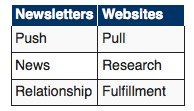
Nielsen notes that readers have different expectations of newsletters compared to web sites. Newsletters create a highly emotional reaction, a bond between the reader and the company. Web sites are all about usability.

“Even a website that you visit daily will feel like a tool where you simply want to get in and get out. The negative aspect is that usability problems have a much stronger impact on the customer relationship.”

Nielsen has lots of advice about writing and designing for scanners, crafting subject lines, opening lines and headings, and making it easy for readers to get on and off subscription lists. Find much of it in the free summary and even more in his full Email Newsletter Usability Report ($398).