Archive for May, 2009

Usability bugs

May 29th 2009

Random petty annoyances in the usability world:

  • When a web site makes me log in, but has nowhere for me to log out.
  • When a site makes me log in more than once (for instance, once to enter a members-only section, and again to comment on a discussion forum).
  • When my e-mail program randomly logs me out. Hello, I can see a security reason if I haven’t touched it for hours, but don’t do it when I’ve just used it minutes ago!
  • When my client’s Outlook logs me out when I’m in the middle of writing an e-mail. Same thing; I get the security aspect of not being touched for hours, but I’m using it!
  • When I send something to print and specify black only, but just because one of the coloured inks is low, I have to push a button on the printer itself that says “print in black only.”
  • When the printer manufacturer bugs me to fill out a survey about my printer use, saying how valuable my feedback is. Then the survey only asks things like how many printers are in the house and if I use them for personal or business use, and doesn’t offer an open-ended question where I can actually give some feedback.

But, hey, it’s Friday afternoon and the sun is shining. So I’m getting off the computer now. If you’re still on, what bugs you?

Expressive language v. 3

May 27th 2009

I just love finding words eloquently or imaginatively written for the enjoyment of readers. Here are more examples spotted recently:

  • “An earthquake will unzipper a fault at two miles per second.” – National Geographic
  • “[Sea lions are] a cross between sea slugs and sumo wrestlers.” – Hidden San Francisco & Northern California, by Ray Riegert
  • “[Extroverts] are as inscrutable as puppy dogs…They listen for a moment and then go back to barking and yipping.” -  Jonathan Rauch’s “Caring for Your Introvert” in The Atlantic
  • “The differences between Web browsing platforms are like the differences between Indian and African elephants, not like those between crabs and eagles. In contrast, email newsletters must contend with platform diversity that is much more like the biodiversity of the Cretaceous Period (before the comet hit).” – Jakob Nielsen in the executive summary of his email newsletter usability study.

Lessons from a garage sale

May 22nd 2009

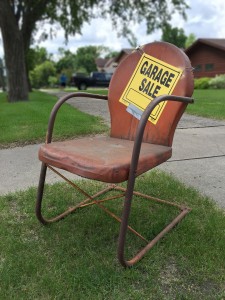
Our basement was crowded with toys, games, puzzles, children’s books and more, the result of two sons, two sets of grandparents, multiple doting aunts and uncles, hand-me-downs from a dozen cousins, birthdays, Christmases and a house of people who keep everything. It was time to get serious about cleaning up, so we held a garage sale. Here’s what I learned.

  • Let go of the concept of value. People think they’ll make a pile of money at a garage sale, but let me tell you, that’s not the case. Garage sale people just want a bargain, and really, YOU just want to get rid of things you no longer need, don’t you? So we priced items low, and accepted offers that were even lower.
  • Team up with your neighbours to make it worthwhile for cars to stop.
  • Talk to people. Some are looking for a particular item, and you might be able to pull it out. Or, you’ll save them time by saying you don’t have it, but your neighbour does.
  • Clear out the front half of your garage. If it’s raining (or threatening to) when you set up, you can arrange the books, clothing and other things that need to stay dry in a way that makes it clear THIS half is for sale and THAT half is not. Leave plastic toys, patio furniture and other things that can handle getting wet on the driveway or lawn to help draw attention to your sale.
  • Think about timing. There will be fewer competing sales on a holiday weekend, but there might also be fewer buyers. Or, the usual number of garage sale fanatics — and there seem to be many of them! — will be desperate for a sale. They won’t be any more willing to pay higher prices, though.
  • Enlist your family. They can help sort items and set up, create and put up posters, help buyers move heavy or bulky items, and take down the posters after the sale. Of course, that means you’ll share the proceeds.
  • The war against clutter is never over in a House o’ Packrats like ours. Make an effort every day to stay on top of things. Regularly set aside clothing you don’t wear, and when you get a call asking for donations to Goodwill or Salvation Army, always say you have some. Look for opportunities to give away things your family has grown out of, including to neighbours who have children the right age.

Some of the same principles (or their opposites) apply to freelancers:

  • Value is everything. If someone balks at your price, don’t immediately drop it, unless you can offer a reduced service for that price. People find the budget for a product or service that has value to them. If you can be “had” on price, then what you offer is just another commodity that goes for the lowest price, and that’s no way to run a business.
  • Team up with fellow entrepreneurs so you aren’t just selling your own specialty but can partner on bigger projects. I’ve partnered with a graphic designer to provide the writing piece of a project he designed, and with another writer on work that was more than one person could handle.
  • Talk to people. They may be looking for expertise that you have or someone you know has. From talking to people at networking events, walking my dog and generally going about my usual life, I’ve been referred for work and referred others, found a handyman, shared some great resources and found some terrific restaurants.

Have you held a garage sale? Let me know if you learned any interesting lessons!

What music speaks to you?

May 15th 2009

Have you ever heard a song, smelled a perfume or tasted food that instantly transported you to another place and time? I had that experience while having lunch the other day with my mom and two sons at the Mandarin restaurant, our after-Mother’s Day treat. The background music was instrumental (elevator music) versions of various easy listening songs. As we walked in, the song was Moon River.

I must have been about six years old, and I remember lying with my head on my mom’s lap, dozing as we drove the winding roads to or from my grandparents’ cottage in the Laurentians. (Bench seats and no seatbelts!) I’m not sure why I connect that song with the trip so much; for sure we crossed a river or two along the way, and maybe there was a moon overhead.

The song is forever linked in my mind to Andy Williams, for whom, apparently, it was never a chart hit. Looking it up, I see that it was originally sung by Audrey Hepburn in Breakfast at Tiffany’s, and it’s since been performed by a diverse crowd that includes Frank Sinatra, Louis Armstrong, Sarah Brightman, R.E.M., Morrissey and Johnny Mathis.

Now, of course, I have it stuck in my head.

What songs bring back memories for you?

An imperfect world

May 11th 2009

The sun is shining and it’s a brand new week. Time for a reminder to be careful out there by looking at some of the recent errors spotted in our imperfect published world:

  • eek out a living” (eke, although I like the frisson of living on the edge that “eek” suggests)
  • “hit the gas pedal instead of the break” (brake)
  • “the kind of place that beacons people to wind down” (beckons)
  • “custom orthodics” (orthotics)
  • “a tight nit group of users” (knit)
  • “researchers who poured through reams of sales and demographic data” (pored over)
  • explanative-laced temper tantrum” (expletive)
  • “then you’ve peaked people’s interest” (piqued)
  • “take a peak at the table of contents” (peek)
  • “the caulendar you used to rinse last night’s pasta” (colander)
  • “seem to be doing a stirling job” (sterling).

Now, let’s hope Muphry’s law is not in effect and I haven’t inserted my own errors!

Hard to find a fold on a web page

May 04th 2009

Have you noticed the use of somewhat dated phrases in modern copy? While they are interesting, I wonder if the reader’s eyes just skip right over the words without registering them. Here are a few examples:

Above the fold” when referring to a web page. The graphic design term refers to locating the most important news story or appealing photo on the top half of a folded page, often a newspaper, considered prime real estate. That same concept has been extended to a web page, where it refers to the portion visible without scrolling.

“Lob it (or throw it) over the transom“: A transom was traditionally the horizontal window over a door in Leave-it-to-Beaver-era schools and offices; it could open and close, and I guess that’s where things were lobbed. These days, you’re more likely to see a fixed fanlight on a fancy house. Throwing an idea over the transom seems to mean submitting something for publication, like an unsolicited manuscript, or delivering anonymous tips.

“Representatives who are too far removed from the coal face to know the details…”: I’ve never worked in a coal mine, but I can imagine that the real work gets done right at the exposed surface of coal, and few executives are nearby. It’s probably right around the corner from the place where the rubber meets the road.

Not quite a dated term but certainly an interesting one: “eating our own dog food.” I had to look it up to find out it meant a company that uses the products it makes. Apparently the reference comes from a TV commercial in which actor Lorne Greene said his own dogs ate the food he was promoting.

I wonder what the lasting words and phrases from the Twitter era will be?