Archive for June, 2009

Car sales? Not my thing

June 28th 2009

My short career in car sales has ended, and thank goodness for that.

As my Honda CR-V’s 10th birthday approached, I planned to buy a new car. I did my research, checking specs and prices online, and narrowed my choice to a couple of cars that offered good mileage, good performance, good looks and were made in Canada. One model got eliminated when I found out it’s only available as an automatic; I like to drive a standard. Two potentials weren’t made in Canada. Another model was great, except for a blind spot that showed up during the test drive.

I ended up buying a Honda Civic, Canada’s top-selling passenger car for the past 11 years.

When it came time to negotiate price, the sales rep told me the dealership would not offer me much for a trade-in, and recommended I sell my old car privately. With previous cars, I always traded in the old when I got the new, but I went with his suggestion.

Having sold the old car last week after two months, here is what I learned:

I need the clean break of a trade-in. Don’t laugh, but having the CR-V and the Civic together prevented me from bonding with the new car. Over 10 years, I had spent a lot of time with the CR-V. My sons had grown to be young men while we had it, and learned to drive in it. It carried just about anything, and it had been a great little car. What was I doing getting rid of it?

It’s hard to negotiate objectively when you have personal involvement. Because I was so fond of the CR-V, it was hard to say objectively, “Here’s what it’s worth.” And because I took the low-key route of simply putting a “For Sale” sign in the back window, the people who ended up putting in offers lived in the neighbourhood. It was hard not to feel a personal connection to them, too, and empathize with their situation.

Putting a sign in the car’s window is surprisingly effective. People who drove by my house called to ask about it. The newspaper carrier asked about it. When I was filling it with gas, the cashier asked about it. Of course, the fact that the car wasn’t an automatic ended many of the conversations, which makes me think it would be useful to post a fact sheet, the way car dealerships do.

If you don’t trade in your car, you end up with two cars. Well, that’s pretty obvious, isn’t it? I suddenly needed insurance on two vehicles, and two sets of license plates.

Transferring a car to someone else triggers extra expenses. To make it easier to sell, I paid for a safety check. Although the CR-V had its “Drive Clean” emissions test last year and was not due for another until next year, transferring ownership meant it needed a new Drive Clean test, too. Grrr.

Anyway, I’m back to one car now, and we’re bonding nicely. The Civic is also a great little car, except for the pale grey seats that show up every black hair left by my Lab; I’m looking for seat covers.

And 10 years from now, when I look at new cars, I’m trading this one in.

Twitter vs. blogs

June 24th 2009

Have you noticed lately that the bloggers you follow are posting a little less frequently?

For me, there’s a direct correlation between deadlines looming and a slowdown in both reading and posting to blogs. I’m disciplined about working when I have to be, and time online is the first to go when I have a lot on my plate. So at times like the busy weeks leading up to a week away on my mini-vacation in San Francisco and then attending the IABC conference, I did not have much to say online.

But something else is getting in the way these days:  Twitter.

Kelly Thul at CommunNtelligence recently voiced that same thought, in a post called “Cheating on my blogging with Twitter”:

“I have resolved to get back to posting to a couple of blogs that I have neglected lately. Trying to understand how I got there. Was I lazy? Sure, always a bit, but that is not it. Did I run out of things to say? Unlikely. I blame Twitter.”

Me, too. First, you spend time scrolling through tweets from everyone you follow to see what they’re up to, and maybe answer or retweet a couple. Then, you have to look at all the interesting URLs they’ve suggested. Next, you might share a few URLs of your own, or come up with something about what you’re doing. And maybe you have some new people following you, so you look at their profiles to see if you want to follow back (or maybe block them, if they appear spammy or in other ways suspicious).  And then, oops, look at the time, better get to work! And so you leave blogging to another day.

Don’t get me wrong, Twitter has its appeal. As Kelly notes, it’s easy and quick, and it’s short. And I think those very attributes encourage a quick comment, which helps to build a connection. People seem to be a little less likely to comment on a blog post, especially if the comment is a one-liner (within Twitter’s 140-characters).

But it’s still an enormous expense of time. So here’s my new plan. If it’s been a few days between posts, I’ll blog first, and not even launch Twitter or (the much nicer tool) TweetDeck until that’s done. Or tweet one day and post to my blog the next. And if I’m super busy, I might not get to either.

How are you achieving blog/Twitter balance?

More SF highlights

June 21st 2009

The 2009 IABC World Conference in San Francisco was a whirlwind of learning opportunities and social events. (Great promotional clip for it here.) Here are some of the highlights:

  • Brian Dunn, COO and soon to be CEO of Best Buy: Down-to-earth, personable, enthusiastic, this year’s EXCEL award winner had many communicators in the audience wishing they worked for/with this man. He used humour and plenty of examples of the cool things Best Buy is doing to reach their Gen Y employees.
  • Robert Swan, OBE: The first man to walk across both the South and North Poles, raising awareness and taking action to save Antarctica. Also plenty of humour and great visuals, although after seeing the almost destroyed heel, I apologize for ever complaining about the tiny blisters I got walking half an hour from the opening reception to the Canada party. Here’s a brief summary of his inspiring message about sustainable leadership.
  • Of course the opening reception at the Ferry Building, followed by the CNW Group-sponsored Canada party. We Canucks have a reputation to uphold (throwing great parties at the IABC conference), and I’m proud to say we did it.
  • The Tuesday evening dinearound is always a fun opportunity to meet new people and get to a restaurant recommended by a local IABC member. I signed up early online, choosing a “North Beach experience” that included dinner at a great Italian restaurant, stops in pastry and candy shops and the City Lights bookstore and a pleasant walk back to the hotel (me in sensible running shoes). My dining companions and I have since connected on LinkedIn. Thanks, Mary!
  • I found the session on communicating with Gen Y interesting. Presenters Leah Reynolds and Anna Whitlow said Gen Y is a “catalyst for change” in the workplace. Something that struck me was the comment that we all want work/life balance; for Boomers, it may be more time with children, while for Gen Y, it may be a sabbatical to volunteer in another part of the world. Another comment: We should ask our Gen Y employees how they want to be communicated with.
  • Angela Sinickas had excellent points to make about measuring communications, including asking the key question, “What do you want people to do differently as a result of your communication?” She commented that the cascading method of communicating (often used in the corporate world, where the top dog shares info with the VPs, who are supposed to share with directors, and on down the chain) is actually the biggest way to feed the rumour mill. She also had good advice on figuring out return on investment and finding low-cost ways to measure. See her top tip here.
  • An interesting talk by BJ Fogg on Design for behavior change: Why Facebook and Twitter are winning. He called Facebook the number one persuasive tool, where even a novice without any particular skill can reach 24 million people. “Big brains probably over-think” campaigns, he suggested, showing a quick “eat a veggie” video he created as an example of simplicity. He said the people you are targeting with your campaigns must have motivation and ability to do what you’re asking, and the often missing piece is a trigger, the “do this now” factor. Look how easily people signed up for Facebook and Twitter, or how you willingly give companies your e-mail address.
  • I always go to a session on writing, since that’s how I spend my days, for inspiration. Again, a conflict, but I chose Ann Wylie on Writing to sell. Some of her advice: Make it relevant to the reader. “More gain, less pain.” Lead with the benefit, support with the feature/advantage. (”Look better naked with David’s Gym.”) Check your focus and how much you are talking about “you” vs. the reader using tag clouds (e.g. TagCrowd and Wordle). Nudge the information closer to the reader. (Not “Death rate drops” but “We’re living longer.”) If the information is irrelevant to the reader, why are you bothering? You want to train people that every message from you is useful and relevant.
  • Building relationships that were started online, as I mentioned in my last post.

Unfortunately, I missed plenty. At least, as an IABC member, I could go online and download some of the presentations, and I’ve been able to find a few recaps on YouTube or individual blogs:

  • I arrived at the conference hotel on Sunday in time to catch just the last 10 minutes or so of Les Potter on Strategic communication planning & management: Fundamentals for success. I already have an electronic version of his The Communications Plan: The Heart of Strategic Communication, but wanted to hear him in person and introduce myself, if there was a chance. Les and I have what I think of as a cosmic connection, having both started our blogs about the same time. (Originally, I thought it was the same DAY, which would have been really cosmic; turns out the date stamp was from the last comment on the first post.) We met, and next day we shared a delightful chat over a latte (thanks again, Les!).
  • Having “all-star” sessions is a great idea, but that means picking just one among a variety of terrific speakers. Even among mainstream sessions, I found several times two sessions I wanted to attend took place at the same time. Thus I was sorry to miss Shel Holtz’s The news release in the social media era (although I listened to his podcast of the session after I got home); Lee Hopkins on 3D virtual worlds (again, found later); Neville Hobson on podcasting (his one-minute summary here); and others.
  • I was on my way to the airport when the closing keynote speaker — Sir Ken Robinson on Finding your passion — apparently blew everyone away. Here’s the poor absentee communicator’s substitute.

Other things I learned:

  • Remember to bring lots of business cards. If you’re doing it properly, you’re meeting new people and exchanging cards.
  • Keep your own business cards tucked into your conference badge so they’re always handy, and then your pocket is available for the cards you get.
  • If, like me, you work in a home office and are more likely to be barefoot or in running shoes than high heels, bring bandaids to cover the inevitable blisters.
  • It will seem like a good idea at the time at the Canada party, but don’t put your Canadian flag tattoos on your face or your cleavage. (Thanks for asking, but mine was on my arm, and it took a lot of scrubbing to get it off.)
  • Take the time to sightsee. I arrived early with my husband to see some of this wonderful city. We spent one night in the city sightseeing, then two nights in Sonoma with my brother and almost-sister-in-law. Toured wine country and visited Artesa, Silver Oak, Provenance, Rutherford and Sterling Vineyards. We dined at some lovely restaurants, and did the real touristy stuff like having a bowl of chowder at Fisherman’s Wharf and Irish coffee and eggs Benedict at the Buena Vista Cafe, watched bakers making bread at Boudin at the Wharf (love the alligator loaves) and saw the sea lions camped out like a pile of puppies in Pier 39’s West Marina.

Were you at the conference? What sessions stood out for you? What ‘don’t miss’ sights did you see?

P.S.  I mentioned in my last post rooming with communications/podcasting ‘rock star’ Donna Papacosta, and that was another highlight I should have included in this list. Donna is a great writer and friend, and you should check out her list of highlights, too!

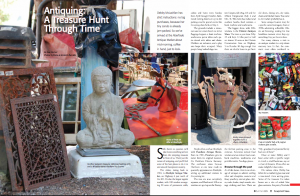
“Antiquing is a treasure hunt through time”

June 17th 2009

(As published in Escarpment Views magazine, Summer 2009.)

Debby McLachlan has strict instructions: no big purchases, because her tiny condo is already jam-packed. So we’ve arrived at the Aberfoyle Antique Market about mid-morning, coffee in hand, just to look.

Still, there’s no question we’ll take home something we love from the tempting treasures in front of us. That’s just the nature of antiquing, and you’ll find some of the best places to do it in and around Escarpment country.

(Read the article)

Sue’s excellent SF adventure

June 17th 2009

Back from the 2009 IABC conference in San Francisco (it’s a week ago already!) and I’ve finally found a few minutes to blog about it. (If you’re visiting from Les Potter’s blog, welcome! Be warned you’ve arrived at the PotterHorn mutual admiration society.)

I’ve blogged before about the value of attending IABC conferences, and I’ve been to many over the years. The professional development is great, the people are warm and welcoming, the social events are terrific (including the traditional hospitality of the Canadian party, sponsored for the second year in a row by CNW Group) and you can usually fit in some sightseeing in fun cities. Everyone has a large badge, so when you encounter in the halls and elevators, it’s your invitation to start a conversation. And that’s the thing with communicators; we barely need an invitation to get started talking.

That was definitely the case this year, but there was also something different happening: More than ever the conference built and cemented relationships that got their start online.

Say what you like about the time it takes to properly use Twitter, Facebook, blogging and other online adventures, it turns out the time can actually be well spent.

This is probably the first time I knew ahead of time that several people were attending, and made plans (that actually came through) to meet. The “warm” connections made by learning snippets of information on Facebook and Twitter and sharing comments on blogs and e-mails all led to a welcome feeling of familiarity with people I had only met online. So when we did meet in person, it was like meeting up with old friends. As Les described it, it was “a continuum of friendship not affected by time or space.”

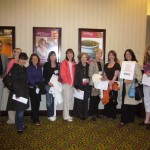
So I had a delightful chat over coffee with Les. I got a warm hug from Linda Johannesson, with whom I’ve corresponded for years. I reconnected with a friend from Calgary I met at the dinearound in New York last year. I enjoyed getting to know fellow Toronto chapter members over dinner and on the walk from the opening reception to the Canada party. I briefly met some of the “rock stars” of communications, like Les, Steve Crescenzo, Shel Holtz and Lee Hopkins. I roomed with another rock star, podcasting queen Donna Papacosta (although we’ve known each other for at least 10 years).

Oh, and since I’ve been back, the people I met at this year’s dinearound have been in touch and we’re now connected on LinkedIn. Since the IABC conference is in Toronto next year, I’ve asked them to let me know if they’re going to attend and we’ll keep the connection going.

So the social piece of this year’s conference was a big highlight. More later on what I learned in the sessions.

Of seagulls and plankton

June 03rd 2009

Some great terms, many from BuzzWhack:

Menoporsche: Male menopause. Symptoms include a sudden lack of energy, crankiness and the overpowering urge to buy a Porsche.

Seagull platform: Generally a break room or common area, where food is left out for employees to eat (donuts, bagels etc.). One minute they’re there, the next they’re gone.

PowerPoint Ranger: Someone with no real-world experience who relies heavily on PowerPoint presentations to express even the simplest of ideas.

Plankton verbs: Also known as “bottom of the food chain” verbs — is, was, are, were. Try to rework the sentence to use strong verbs instead, like earn, devour, squander, shriek or slouch. (Thanks to Shannon Paul on ProBlogger for this one and Daphne Grey-Grant for the action verbs.)