Archive for August, 2009

Tips to regain your daily focus

August 31st 2009

Usually, I’m very disciplined about writing. After walking my dog in the morning, I’m at my desk at 9 a.m. I turn the sound off so I’m not distracted by the whirr of arriving tweets, or the siren song of e-mail in my in-box. I don’t even listen to music so I can concentrate.

So what the heck happened to me a couple of weeks ago? I hit a spell where I just could not focus. I was distracted by e-mail and spent too much time reading blogs and following alluring URLs posted on Twitter. True, it was high season for vacations and I had a hard time reaching people I had to interview. But really; I had to do the equivalent of grabbing myself by the scruff of the neck to get my own attention.

If you get caught by the same lack of focus, here are some ideas to help:

  1. Write out a list of everything you must accomplish. Rewrite it each night to be ready for the next day.
  2. Don’t even open Twitter until you’ve crossed something off your “to do” list.
  3. Turn off the sound so you don’t hear incoming messages.
  4. If you leave your mail program open, block the view of your in-box so you can’t see incoming messages either.
  5. Only allow yourself certain times to check e-mail, Twitter, Facebook, blogs, etc. and STICK TO THEM.
  6. Get a timer and be disciplined about how much time you spend checking all those online funhouses.
  7. In extreme cases, take your laptop somewhere where you don’t have access to the Internet.
  8. Give yourself a reward for the tiniest of achievements, such as staying focused for a set amount of time, and for bigger successes like finishing an article or submitting a project.
  9. Know that this, too, shall pass.

Having just completed two last-minute projects (quick turnaround of about a day from interview to finished article, something I like to call “pulling a rabbit out of a hat”), I think I’m recovered. At least for now. But if you noticed that I haven’t said much on Twitter lately, this is part of the reason why.

Oh, and I should add, we need to cut ourselves some slack. As long as you are meeting your commitments, it’s OK to work at a slower pace once in a while!

Secrets & six strings

August 28th 2009

Here are some interesting items I came across this week:

  • PostSecret.com: Frank Warren started PostSecret.com as a community art project. Since November 2004, he has received more than 150,000 postcards, each sent anonymously and containing that person’s secret. The web site receives more than six million visitors a month, viewing the shocking, soulful and laugh-out-loud funny thoughts and feelings shared by these secret donors. Warren has turned the postcards into five books, the most recent being PostSecret: Confessions on Life, Death, and God. “I feel like a kid waking up Christmas morning when I’m walking up to my mailbox,” he said in an interview.
  • Six String Nation: One unusual guitar, 64 pieces, six strings and one Canada. This unusual guitar features pieces of Canadian history and heritage representing different cultures, communities and characters. For instance, there’s a caribou antler carving from Nunavut; a piece of gold from Maurice Richard’s 1955-56 Stanley Cup ring; and part of a seat from Massey Hall in Toronto. The guitar was conceived in 1995 by writer and broadcaster Jowi Taylor, inspired by the Quebec referendum looming that year. Taylor gathered the materials and had the guitar crafted by luthier George Rizsanyi. Nicknamed Voyageur, the guitar made its debut at the Canada Day celebrations in Ottawa in 2006. Since then, it has travelled thousands of kilometers across Canada, been played by hundreds of musicians and held by thousands of Canadians.
  • Heathrow’s writer-in-residence: An article in the Aug. 27 Toronto Star (”A novel view of airport customs” by San Grewal) described the writer-in-residence program at Heathrow Airport. Swiss author Alain de Botton spent a week at Heathrow, observing travellers coming and going, and is now writing about his observations and experience. Publisher Profile Books will give 10,000 copies of the book, to be published Sept. 28, to Heathrow visitors.

What gems have you found in your online travels?

Love is a 4-letter word

August 23rd 2009

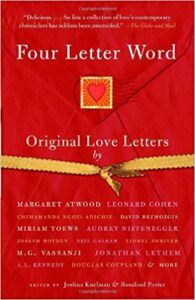
Has anyone read Four Letter Word: Original Love Letters (edited by Joshua Knelman and Rosalind Porter)? Although one reviewer said it “unleashes the romantic in all of us,” I didn’t find it that way at all.

Confession: I am a hopeless romantic. Actually, make that hopeFUL romantic. So I looked forward to reading this collection, described as “testimony to the creative powers of our leading writers…each guaranteed to seduce.”

Each piece was indeed “radically different from the others,” as billed. While the pieces are set up as letters, they are really more like short stories in some way related to some kind of love. For instance, there’s a stalker, a daughter writing to her dead father, an e-mail exchange sent to the wrong address, an ode to a house. Yeah, a house.

In 245 pages, only two passages really spoke to me:

“I cannot wait to hear your voice again. This is such a frustratingly cold medium in comparison to the heat of your touch, the warmth of your smile, the glow of your expression when you catch my eye.” (Lionel Shriver)

and

“…the town is behind me, the moon rides gloriously high above and I am scudding along the coast road towards Llanystumdwy. Ah, I feel the ecstasy rising! That light beyond the woods up there? Can it be your light? Is the breeze from the sea stirring your heart at this moment as it stirs mine? Is your kitchen door open for me, with a flicker of your firelight brightening the yard? Oh my love, my light, my glory! I am coming! You are waiting!” (Jan Morris, talking about “my one and only house”)

So now I’m in search of Other People’s Love Letters: 150 Letters You Were Never Meant to See, by Bill Shapiro, which sounds more like what I was looking for:

“Fevered notes scribbled on napkins after first dates. Titillating text messages. It’s-not-you-it’s-me relationship-enders. In Other People’s Love Letters, Bill Shapiro has searched America’s attics, closets, and cigar boxes and found actual letters — unflinchingly honest missives full of lust, provocation, guilt, and vulnerability — written only for a lover’s eyes…what at first appears to be a deliciously voyeuristic peek into other people’s most passionate moments will ultimately reawaken your own desires and tenderness…because when you read these letters, you’ll find the heart you’re looking into is actually your own.”

Now, doesn’t that sound like something for a hopeful romantic?

We heart Best Buy CEO

August 19th 2009

Best Buy CEO Brian Dunn had the communicators at the IABC conference in San Francisco in June in the palm of his hand, as I mentioned talking about highlights of the conference. He seals the deal with this interview in the The New York Times published August 15. If you haven’t seen it yet, go read it!

One of the comments that captures his down-to-earth personality:

“You’re never as good as they say or as bad as they say. When I was made CEO on June 24, I didn’t wake up that morning smarter. I didn’t wake up with a massive I.Q. expansion.”

I particularly love how he weaves stories into his conversation:

“Let me tell you a quick story that I think will illustrate it the best…” (and it does)

and the enthusiasm he displays:

“I love my gadgets and I’ve got to tell you why.”

which launches into a heartwarming story about virtually watching a basketball game with his sons, which ends:

“The only thing I can’t do is put my arm around them.”

As I said at the conference, he pretty much had us at hello!

Make surveys make sense

August 17th 2009

Customer/employee surveys are important. I know this, and I try to go along with companies who take the time to survey me as a customer. But they need to do a better job of asking questions that are both within the customer’s ability to answer and that they can do something with.

Take my bank, for instance.  It just had a survey company call to ask about my experience as a business account holder. It was a nice gesture, but frankly, it was a waste of my time and theirs.

The questions mostly began, “On a scale of 1 to 9, do you think…”.  They wanted to know whether I thought the bank cared about me as a customer (not particularly; banks in general seem to nickel and dime customers, and they’re quick to charge interest but slow to pay it). They wondered if I felt appreciated (can’t think of anything the bank has done to show appreciation) or had been made to wait too long (more than once). They wondered if I had a relationship with the person managing my account (there’s a person managing it? really?). And they took at least eight minutes to run through it all.

If you’re going to survey someone, one of the first rules is that you only ask a question when you can or plan to do something with the answers. So is the bank going to change anything if the survey people find that 75 per cent of customers don’t feel appreciated, and 85 per cent don’t think the bank cares about us? Can we look forward to hand-written notes of appreciation or an extra 0.5 per cent interest on our accounts? I doubt it.

By all means, survey your customers. But make sure to ask questions that they can actually answer and that will give you information you can and will act on. And if someone repeatedly says, “I can’t answer that” or “I have no idea,” think about changing the question.

Expressive language v.4

August 13th 2009

Here are more great examples of words eloquently or imaginatively written for the enjoyment of readers:

  • “The files holding the data are as thick as unabridged dictionaries.” - Joshua Wolf Shenk in The Atlantic, “What Makes Us Happy?”
  • “I’m at home a lot, begging for quiet from a child who has the same need for exercise as an Arabian horse.” - interview with Quinn Cummings on her blog book tour, on Quiet Elegance
  • “Big waves were front-page news around here this weekend…We went to the beach to see Mother Nature show her teeth, and though I have lived my entire life in Southern California, I’d never seen waves that breathtaking.” - Danny Evans on his blog, Dad Gone Mad.

Have you seen any great examples to add to my collection?

Zappos CEO gets it

August 10th 2009

It’s so refreshing when a CEO sends out something that actually sounds like a human being might have said/written it. That was the case when Zappos‘ CEO, Tony Hsieh, issued an announcement July 22 about Amazon buying Zappos.

I liked that he apologized “for the occasional use of formal-sounding language,” saying that “parts of it are written in a particular way for legal reasons.”

I liked that he set out the “top 3 burning questions” and he answered them, with #1 being “Will I still have a job?” (Of course, you could take “Your job is just as secure as it was a month ago” more than one way.)

I laughed at his answer to “Will we get a discount at Amazon?”: “No…And we’re not going to be giving the Zappos discount to Amazon employees either, unless they bake us cookies and deliver them in person.”

I liked the cover-up for legal phrasing: “Can you talk like a banker and use fancy-sounding language that we can print in a business publication?” and “Can you talk like a lawyer now?”, followed by “Can you please stop?” “okthxbye.”

In sharp contrast are the weasel words that came in March from a surprising source: Sesame Street. Yes, the folks behind all those clever, catchy rewrites of contemporary songs issued a news release that they were culling 20 per cent of the workforce; they had “to operate with fewer resources in order to achieve our strategic priorities.” Oh, let me think, that would be cutting staff? Why yes, 67 people in fact.

If you’re helping a CEO issue a statement of any kind, please, please do your best to make him/her sound like the human he/she undoubtedly is.

okthxbye

Hit or miss(ed) opportunities

August 04th 2009

A thank you card arrived today in my mail, signed by someone I had never heard of. Turns out she is part of my local library’s summer reading program, just one of the programs the library notes it is able to run thanks to me and other donors to their literacy efforts. “Ella” carefully printed out why she loves the program: “It’s good for my brain to read.”

What a terrific follow-up marketing piece.

I can think of a few marketers who caused the opposite reaction and missed an opportunity, although I won’t name names:

  • My cellphone provider: A three-year contract was coming to an end. In the weeks leading up to the anniversary date, I noticed an increase in call-centre calls (identifiable by call display; I did not answer them, and the callers did not leave a message). I was thinking about switching providers, because I didn’t want to sign up for the same length of time or the same relatively expensive plan, complete with monthly system access fee, and I wanted to add the ability to send text messages without being charged as much as the old provider. Still, the old company could have tried to keep me as a customer. If they were the ones calling, they could have left a message. Or they could have contacted me by mail, noting that the anniversary date was approaching and offering some attractive options to encourage me to stay. No, they did nothing, and I went to a different provider. I ended up with a shorter term, less expensive monthly fee, more options, no system access fee and a better phone.
  • The local spa:  About a week before my birthday, the local spa sent me a certificate worth $10 off a treatment; a nice gesture. Unfortunately, it had to be used within about a week and I didn’t have time to use it. Here’s what they could have done: contacted my husband, who has bought me certificates there before, and offered him $10 off any certificate he might buy for me for my birthday. They get the sale and the brownie points that go with giving a discount; he gets a deal and brownie points, too; and I get to use the treatment! Sounds like a winner all around.
  • The local wellness centre: Earlier this year, I went through nearly weekly treatments for a sore shoulder. First, it was physiotherapy. Then, I tried acupuncture. The acupuncturist/wellness centre director also tried a cold laser treatment. Nothing really did much, and we discussed “doing nothing” as an option before I agreed to try therapeutic massage. I tried one session but didn’t find it much help either, so opted for doing nothing but continuing the exercises the physiotherapist had originally given me. Still, I found it surprising that no one at the centre contacted me in the months since I’ve been there to ask how the shoulder is, offer a free evaluation of the shoulder or suggest an alternate treatment. But maybe I’m expecting too much.

It’s a good reminder to look around and see if there’s a marketing opportunity your business is missing.

Watch out for jargon

August 02nd 2009

When interviewing someone for an employee newsletter article, I always ask the meaning of unusual terms, acronyms (a word, like OPEC, formed from the initial letters of other words) and initialisms (a group of initial letters pronounced individually, like CBC). People often reply, “Everyone knows what it means” because they are insiders familiar with the industry’s jargon — and every industry has some — but it’s my job as writer to assume that someone won’t. So I explain what the mystery term is up front.

Probably the worst culprits for throwing around industry jargon are sports commentators.

The men in my household are all sports fans, so I’ve heard a lot of the terms. In hockey, players don’t just get a goal, they go “top shelf” or “roof daddy,” possibly when the other team is unsuccessfully “on the PK” (penalty kill). In baseball, an easily caught fly ball is a “can of corn,” a fastball is “cheese” and a pitcher can be said to “have some good giddy-up.”

Earlier this year, I ran into a whole new vocabulary listening to commentary on curling. This is a sport I know nothing about, so I had no idea what the announcer meant talking about “hit through the hole,” “last draw” and “threw a runback hit and stick for three.” Whaaat?

A friend has taken up lawn bowling; yep, it’s got it’s own jargon, too. A ball is actually a “bowl,” and there are “backhand draws,” “hammers,” “hog line” and “bowling to the Jack.”

Writers have their own secret words, too, as I was reminded when reading a fiction writer’s blog. She talked about “wip” (which from the context seemed to mean work in progress), “pubbed nonfic writer” (published non-fiction writer), “ms” (manuscript) and “SASE” (self-addressed stamped envelope).

Sports announcers can get away with their jargon only because many of the listeners are fans and followers of the sport. As insiders, they get it.

Writers shouldn’t assume any such thing.