Archive for January, 2010

Is the client buying ‘you’?

January 29th 2010

While at the dentist’s office recently getting my teeth cleaned, the dental hygienist mentioned something we both found shocking: The dentist got his wife’s sister to buy everything for his wife’s Christmas stocking.

Okay, so spinmasters will say Dr. P. was “outsourcing” the work because he was so busy working. Oh, please.

I say he should be able to spare 10 minutes to duck into the drugstore and buy a few simple things, showing that he pays attention: knowing/buying the cosmetics his wife uses, the chocolate she likes, the perfume she’s been wanting…you get the picture. His wife has a right to expect something from him and it’s just not the same if someone else does it.

At a networking event the other night, we were talking about entrepreneurs who use “& Associates” with their name. Someone wondered if it’s ethical if the contract says “I will do X” but then we subcontract the work so someone else actually does X.

The answer, of course, is “it depends.”

Is the client “buying” you and you alone, or just a product or service? Is the client the kind of wife who wants her husband to pick out a personal, meaningful gift, or the kind of wife who just wants an expensive gift?

Sometimes the client truly wants you; for instance, you’ve made a name for yourself in your flare for media relations, or your ability to put someone at ease and get a great interview. If you’ve promised that you will be the one doing this, the client is buying YOU.

But sometimes the client just wants the work done. Your firm has the reputation for getting things done, and the client is happy to hire you, knowing you’ll look after everything. So if you write a media release but you subcontract media calls to someone else, that may be fine. In that case, though, you should make it clear — specifying in your contract or letter of agreement — that you occasionally work with others and “we” will handle X. And you certainly should review your subcontractor’s work and make sure it meets your standards.

Do you agree?

Bell’s upgrade looms

January 20th 2010

As the end of January approaches, I’m a little nervous. Bell has alerted me that they are “making changes to our e-mail systems which will require you to update the settings on your e-mail software…Please note that if you do not update your settings by January 31st, 2010, you will no longer be able to receive your e-mail.”

Does that seem like excellent customer service, to make a change that could possibly result in customers not being able to use the service they have paid for?

Bell has helpfully provided an “Internet Check-up” tool to see if any updating is needed. Oh, but too bad for me, it’s “currently only compatible with Windows.” As the Bell site curtly informed me, “You are running a Macintosh operating system.” Not to worry, though; “Efforts are ongoing to provide a Macintosh compatible version as soon as possible.”

Bell has been tinkering with their system for a few months now, causing random unexplained grief. First, the mail system stopping playing nice with the e-mail program I use. Then, I discovered that I had somehow been given a limit on how many messages I could send in 24 hours, without being told I had a limit. So although I administer a mailing list of about 230 association members and have been regularly sending messages to them for about two years, I suddenly got an error message that said, “Requested action aborted. You have reached the limit for how many messages you can send in 24 hours.”

I tried to e-mail Bell’s support account to find out what was going on, but of course I was over my secret limit. So I tried online chat and found out my limit was 250 e-mail messages a day. When I explained my problem and asked that my limit be raised to accommodate the mailing list I administer, here’s what happened:

Bell: I would need to escalate the issue to a higher tech support to get this issue resolved.

Me: Please do so.

Bell: I suggest you wait for 24 hours for the limit to be raised.

Me: You mean I can’t e-mail anyone else today?

Bell: Sorry to say a yes.

Me: That’s not very responsive service. I can certainly wait 24 hours to send a bulk e-mail but another 10 to 15 today doesn’t seem like much to arrange.

Bell: I do understand your concerns but we need to wait.

Well, the limit has been raised, although I didn’t get official notice of it and have no idea what it is. All I know is that I’ve been able to send several bulk mailings to the group. But you see why I am a little worried about the changes happening January 31.

So if you are a company upgrading your systems, please make sure it’s a change that will actually improve customer service. Otherwise, you are just like the companies who advise they are “changing” their fees when really they mean “increasing your fees” — it’s not good news to the customer.

Newsletter memories

January 16th 2010

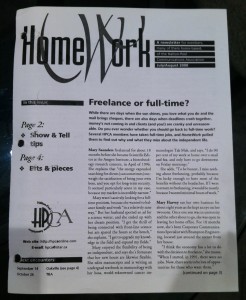
While cleaning out my files this week, I came upon a stack of back issues of a four-page print publication I used to write and produce as a volunteer for one of my networking groups for entrepreneurs. Before recycling the pile, I went through it and kept a copy of each issue, filing them neatly in a binder. (This is part of the reason I need to declutter fairly often; you’ll find a sample of just about everything I have ever written somewhere in my office!)

As has happened, sadly, to many a print publication, this one no longer exists. It was a controversial decision that I won’t get into here. Suffice to say a number of us mourned and still feel its loss, despite its eventual replacement with an electronic version.

As I flipped through the issues, enjoying the smooth touch of the paper and the simple, clean design (by one of the group’s talented graphic designers), I was pleased to see that the content stood the test of time. We have a number of talented writers in the group who contributed, and it showed. The newsletter covered a variety of useful tips for things like riding out the peaks and valleys of solo work, cold calling, dealing with “scope creep” and maintaining a professional business with children home during the summer. The newsletter introduced new members and shared updates on projects in which existing members were involved. If you couldn’t make it to one of the regular meetings, you knew you’d be able to read about it in a summary that was the next best thing to being there.

Don’t get me wrong; e-newsletters can be great, and I subscribe to quite a few. The best make sure the content is king, with useful guidance on whatever the newsletter topic happens to be. And they are regular; if the newsletter is monthly, you get one every month. Although many people think an e-newsletter has to be flashy, a strictly text newsletter is fine; looks aren’t that important if the content is there.

But what’s so great about print?

  • It’s portable. Employees can read it on the bus or subway, and take it home to share with their families.
  • It’s easy to keep. You can file it and refer to it later, as our independent communicators often told me they did.
  • It’s easier on the eyes than staring at a computer screen.
  • It can be more economical than something employees read online, since many times they will print it out at work anyway, at higher expense than the bulk printing of hard copies.
  • Not everyone has a computer. I know, it seems like we all do, but what about truck drivers? People who work in a mine or in construction? They may have shared access to a computer at certain times, or are connected by a BlackBerry or other mobile device that isn’t the best place to view an online newsletter.

Respected communications expert Dr. TJ Larkin notes that “The Web is best for short, quick, information retrieval. The Web user is a hunter: leaning forward, senses pricked, visually aware, searching and eventually tracking down the targeted information. This is a great mental state for searching but a much poorer one for comprehending.”

Dr. Larkin says companies should “think paper” when communicating things like a major change to benefit plans, a big strategic change in business direction or a new software application. “Messages that are new, long, and complicated belong on paper, not on Web pages,” he says. “Paper’s strength is comprehension. People use the Web — they read paper.”

(Download Dr. Larkin’s free report, Communicating Big Change Using Small Communication, at www.larkin.biz > Publications.)

Ways to help Haiti

January 13th 2010

Disaster puts our petty little problems into context, doesn’t it? If you feel inclined to help the people of Haiti struggling after yesterday’s earthquake, here’s a suggestion:

My colleague (through the Halton-Peel Communications Assocation) Marnie Hughes was project coordinator for the International Conference of Healing Hands for Haiti in Toronto last November. She says, “I was fortunate to meet many individuals from Haiti, Canada and the U.S. who have dedicated the past 10 years to providing rehabilitative medicine and education to the disabled of Haiti. After yesterday’s devastating earthquake, what is left of their facility will be put to use helping, where possible, even more vulnerable Haitians. It would mean a great deal if you would consider directing your help to www.healinghandsforhaiti.org. Thank you very much for considering this.”

As always, the American Red Cross and Canadian Red Cross are also providing assistance. And so is Free The Children.

Start your networking engine

January 12th 2010

I’ve talked before about how referrals magically help you diversify your business, and how networking can lead to the connections, the trust and the work that leads to referrals. December is a busy month, but I’m more likely to be meeting with friends and family than building my business network. January is a different story, and I’m gearing up for three networking and professional development events in the next two weeks:

Wednesday, January 20, 6:30-9 p.m.
Halton-Peel Communications Association (HPCA)
“What’s your behaviour style?”

Location: Glen Abbey Library, 1415 Third Line, Oakville, ON
Paula Hope of the Referral Institute will walk you through how to evaluate your network and relationships, create messages to build on those relationships for business, and understand behaviour styles so you know how to get your message across. In short, WHO are you talking to, WHAT are you saying, and HOW are you going to say it? (Note: If there is still small print that says the event is closed, ignore it; it’s not. If the button does not work, register with Marnie Hughes.)

Thursday, January 21, 6-8:15 p.m.
International Association of Business Communicators (IABC)
“The secret to engaging employees: How to bridge the great divide and get your employees’ buy-in”
Location: Sutton Place Hotel, 955 Bay Street, Toronto, ON

Never before has there been such a diverse workforce driving business. Each generation is hearing your message through their own generational filter. Each generation has different issues that are important and wants to hear the message in their own way — text, video, email, phone call or face-to-face. Now add in weak management practices and the reluctance of the C-suite to be more forthcoming, and you have difficulties that intensify during times of change and turmoil. The panel includes:
Laurie Smith, who will discuss how to prepare your leadership team and communicate during times of challenge and change.
Leah Reynolds, who will present the business rationale for adapting communication practices to be in line with changing generational perspectives, and discuss the steps that communicators need to take to stay in step with these changing times.
Donna Papacosta, who will take you on a quick tour of the ways in which Web 2.0 is transforming employee communications.
(Note the IABC member/earlybird fee of $45 ends Jan. 14.)

Wednesday, January 27, 6-8:55 p.m.
IABC/Toronto’s Alliance of Independent Practitioners (AIP)
“Successful independent practitioners 101: How they got where they are now”
Location: The Assembly Hall, 1 Colonel Samuel Smith Park Drive (Kipling/Lakeshore), Toronto, ON

This panel discussion will cover how to market yourself to attract the clients you want, how to grow your business to achieve your financial goals and how to avoid pitfalls standing in the way of your success. Learn insights and tips from these entrepreneurs:
Paul Lima, freelance writer and author of Six-Figure Freelancer: How to Find, Price and Manage Corporate Writing Assignments
Diana Degan Robinson, president of Diana Robinson & Associates and winner of IABC/Toronto’s 2009 Award of Distinction for Independent and Small Agency of the Year
Ken Cherney, ABC, APR, MC, award-winning senior communications practitioner at Ken Cherney and Associates Inc.
Annette Martel, ABC, MC, award-winning independent consulting associate, TWI Surveys Inc. and frequent guest speaker at IABC world conferences.

Have you started up your networking engine yet in 2010? Will I see you at one of these events?

Project declutter underway

January 06th 2010

The start of a new year always seems to prompt at least a couple of weeks of good behaviour. Yeah, this is the year we’re going to lose 10 pounds, learn a new skill, get organized. And so I found myself looking around at the mess in my home office over the holidays, thinking, “This has got to change.”

I started small, with a shelf of files and the desk drawer that is the equivalent of every kitchen’s “junk drawer.” Here is what going through them taught me to do differently this year:

  • BUSINESS CARDS
    About 40 cards were shoved in a corner of the drawer in no apparent order. I spent some time sorting these out and filing them, noting that some had written reminders on the back of where I had met the person and if I had promised to follow up with something.
    To do:
    This year, I vow to deal with any business cards by first searching for the person on LinkedIn and asking for a connection. You could argue that once the connections are made online, I could throw the cards away, but for now let’s say I’ll keep them, entered in contact management software and/or physically filed. I will make sure to write on EVERY card where I met the person.
  • STUFF
    I can’t tell you how many pens, shells of pens waiting for refills, stubs of pencils, bits of paper, calculators with no batteries, paper clips and labels were stuffed in that drawer. Clearly, I had long ago abandoned any semblance of order and at some point began just tossing things in there just because I didn’t have another place to put them.
    To do:
    This year, I am finding proper homes for more things and keeping them there. I am putting the pens that work in a mug on my desk, and throwing out more things.
  • PAPER
    We never really believed in paperless offices, did we? And I sure don’t have one. Two areas in particular have been messing up my office. (1) When I interview someone for an article, I print out the notes and keep them until the article is published. This is helpful because sometimes I have had to refer to the notes during the approval process, to add more detail or clarify a point. But somehow the notes have been multiplying when I’m not looking. (2) I have active files in at least three places besides the actual filing cabinets. Sometimes the files there aren’t actually active any more and should be moved out of the way. And I almost always drop things behind or trip over one of these places.
    To do:  This year, I will return to the notes within a month or so and shred them if they contain any sensitive information, or recycle them if they don’t. And today I am picking up a few supplies I need to combine all three spots into one place for active files, getting rid of the one that trips me.

There’s more to be done, but this is a start.

How do you stay on top of clutter in your office, especially when you are busy meeting client deadlines?