IABC conference

Going green? Get the guide

June 16th, 2010

IABC/Toronto's Green Guide

In all the excitement of the IABC 2010 World Conference last week, I forgot to point out the excellent Green Guide put together by IABC/Toronto’s Corporate Social Responsibility committee.

The guide is designed to provide “best practices, communications planning and success stories in green marketing communications, sustainable and corporate social responsibility (CSR) practices.” There are sources for vendors who provide ecologically responsible materials, tips for implementing environmental practices within an organization, a glossary of terms and examples of successful green campaigns.

The guide was written by my fellow Toronto independent Frances Roberts of Push Communications. Bernard Hellen, R.G.D., of traffic marketing + design inc., did the layout, and (ahem) I handled editing and proofreading. I’m torn between saying “tell me if you find any mistakes I missed” and “DON’T tell me”! Either way, I’d love to hear what you think.

Download a copy under “Green Guide” from IABC, or here: IABC/Toronto GreenGuide.

More IABC10 highlights

June 11th, 2010

Yesterday, I promised more highlights of the  IABC 2010 World Conference in Toronto. Here are some of the takeaways from individual sessions (check IABC for handouts) in roughly the order experienced:

In Strategic Communication Planning, Les Potter, ABC (friend and cosmic blogging partner) said a quick way to determine the issues that need to be treated is to ask your CEO “What keeps you up at night?” Regarding tactics, face-to-face communication has the least reach (it’s hard to get your CEO in front of every employee) but is the most persuasive and powerful, especially if you’re trying to move people from awareness to acceptance to action. Les also said don’t wait until the end of a cycle or year to see how your plan is doing; do some sort of check every quarter so you can adjust as you go along.

When conducting communication audits, Karen Vahouny, ABC and Tracy Finneman suggested we determine what key information we really want to learn, and what will drive better employee decision making. Also check your communication channels; are they useful, clear, timely and relevant?

Julie Gebauer noted in Closing the Engagement Gap that due to the recession, people are thankful to have a job but disgruntled from pay decreases, few opportunities for promotion and low or no bonuses. To engage these workers, we need to appeal to three dimensions: think/feel/act (or head/heart/hands). Help employees understand how they can advance their own careers and how their work affects the company. Julie gave a great example of a hospital, where the people who clean the rooms were found to have a huge effect on patient satisfaction.

An energetic Gregg Lederman led a session on Engaging Employees to Out-Behave the Competition. Brand integrity, he said, means you are who and what you say you are — but if you don’t define the specific behaviours you want, people will make it up. Set expectations for what to think and how to behave; capture examples and communicate those expectations; and hold employees accountable. This includes positive consequences when employees do it right. “Don’t ration praise like it’s going to be gone.”

In Why Should Anyone Trust You?, Veronica Hope Hailey warned that lack of trust is not due to the recession, but was already an issue. She had us write our names with our non-dominant hand (a change) to remind us of the feelings that change elicits — feeling unsure, incompetent, at risk. “When you feel like this, you need leaders you can trust,” she said. Repairing trust includes dialogue, really hearing what people feel and think, and dealing with people fairly.

Mark Evans talked about Social Media Beyond Tweets, Followers, Digg, Updates, etc. His somewhat contrary opinion was that instead of a “dangerous obsession with metrics,” we should be spending our time telling stories that engage the audience, educate, entertain and inform. Rather than having a snippet of conversation with every single person (think Twitter), we should be connecting with a smaller number of people and having a real conversation.

William Amurgis shared a fabulous view of what a corporate intranet can be in How to Transform your Corporate Intranet. If your intranet isn’t keeping up with Facebook, Google, Twitter etc., he suggested, you’re failing. Thus the American Electric Power intranet features blogs, community pages, a photo of the week, personal pages and lots of discussion and interaction. His advice: keep it simple and relevant; enhance employee productivity; reinforce corporate messages; provide a place for everyone to meet; and have a personality. My only quibble is that he did away with an employee newsletter!

Katie Paine talked about her favourite topic, measurement. The key is defining what’s important. So if your CEO says, “We kicked butt this quarter,” what does that mean? What problems have you solved? Did you build relationships, generate leads, get the word out? Once you decide your performance indicators, pick your measurement tool, such as listening tools and web analytics, surveys and samples. (Shel Holtz recorded and posted Katie doing a similar session.)

As always, because I’m a writer, I like to get inspired by attending a session on writing, and so ended up the last day with Ann Wylie’s Six Secrets of Persuasion.  They are (1) exert authority (quote experts and authority figures; (2) deliver less (offer A, B or C options and don’t confuse people with too much choice); (3) become a social butterfly (people are more likely to do what they see others doing); (4) practice likeability (find and point out things we have in common); (5) pull the trigger (use an environmental trigger to change the way people behave); and (6) make it about MOI, or My Own Issues (writing about the reader’s issues, not yours).

Were you at the conference? Which sessions stood out for you?

IABC 2010 World Conference-goers Donna Papacosta, Diana Degan Robinson and Sue Horner.

Part of the fun of attending IABC World Conferences is catching up with friends. My roomie Donna Papacosta is here (far left) with Diana Degan Robinson and me.

Another excellent IABC adventure

June 10th, 2010

IABC 2010 World Conference

I’m back at my desk, trying to turn my brain back to reality after another terrific IABC World Conference.

Once again, I was able to put faces to names of people met online, mostly on Twitter, and reconnect with others met at previous conferences, friends and colleagues. As always, the professional development was solid, the people warm and welcoming, and the social events good fun. We had a great turnout of independents among the 1,400 participants and wore our indie ribbons proudly. And our shopping guide appeared to be a hit!

The official conference start featured the energetic drumming of the Drum Cafe; my hands were sore for a day after joining in! Next came the elegant opening reception at the Royal Ontario Museum Sunday night, followed by the traditional Canada party (sponsored by CNW Group). Unfortunately, I missed the party, but apparently my fellow Canucks held up our reputation with dancing until 2 a.m.

I have to confess that this year’s EXCEL award winner, Xerox’s Kevin Warren, did not generate the same enthusiasm in me as previous recipients did. His speech was very scripted and full of jargon; anyone playing “buzzword bingo” would have achieved bingo in the first 5 minutes. However, his more engaging and casual self emerged during the question-and-answer session.

Tuesday’s general session featured an inspiring talk by Craig Kielburger, co-founder of Free The Children and Me to We, talking about the value of bringing the non-profit perspective to the business world.  “People are desperate for meaning and want to know their jobs make a difference,” he said. Tap into that by building a culture of empathy (listen, don’t make assumptions), community (work together for the common good), meaning (celebrate success) and legacy (build a team and plant the seeds).

Guy Kawasaki closed the conference on Wednesday talking about the Art of Innovation, gaining enormous Canadian brownie points by sharing his love of hockey. He also earned applause by repeating his 10-20-30 rule of pitching: the optimum number of slides in a presentation is 10, given in 20 minutes, using no smaller than 30-point type. Although he had a few more than 10 slides, there were 10+1 main points about innovation, including make meaning (be motivated by how you can change the world, not just how you can make money); don’t worry, be crappy (when your product is revolutionary, don’t wait for perfection, fix the crappy parts in version 1.2); and let 100 flowers blossom (people who aren’t your intended prospects will buy and use your product for untended purposes; let them).

As happened in New York and San Francisco, I roomed this year with my friend, colleague and podcasting expert Donna Papacosta. Even though the conference was local this year, staying at the hotel saved us from horrible commutes and we split both the costs and the fun. Thanks, Donna!

In all, it was time well spent. Now it’s back to work to make up for all that time away from my desk, and I’ll share some of the session highlights another day.

Interested in my past IABC World Conference adventures?

IABC shoppers, start your engines

June 3rd, 2010

Sooner or later, when you find yourself in a new city, you probably do a bit of shopping. Maybe you pick up a souvenir to take home, or you replace a shirt that has miraculously sprouted a coffee stain, or you need some toiletries.  But where do you go?

Something I have often thought of but never found while attending an IABC World Conference is an insider’s guide to shopping in that city. Where do the locals go to buy a pair of jeans, for instance? What’s the best spot for souvenirs? Is there a place close to the hotel I shouldn’t miss?

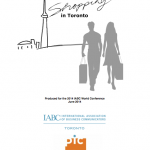
So with the conference coming to Toronto June 6-9, IABC/Toronto’s Professional Independent Communicators, local colleagues and I have been working on producing The Insider’s Guide to Shopping in Toronto. And I’m happy to say it’s done.

As the guide notes, there are plenty more stores than are listed, but we’ve tried to keep recommendations to those from someone we know and that are within a reasonable distance of the conference hotel.

Particular thanks go to Christina Scicluna, who was an invaluable resource in sharing the results of her own personal adventures and pulling together recommendations from other friends and colleagues, and Teri McMahon, R.G.D., who designed the guide. I’d also like to thank the numerous people who responded to my requests for recommendations on Twitter or email.

For more online shopping advice, visit Modern Urban Guides, Toronto Life Shopping and Toronto Shopoholic, a blogger I found via Twitter but too late to get into the guide.

Want to see? There will be a small number of print copies at the hospitality desk during the conference, or download The Insider’s Guide to Shopping in Toronto now:

IABC/PIC Toronto Shopping Guide

And I’d love your feedback!

Tie a ribbon on for IABC 2010

May 13th, 2010

Toronto independents get ribbon for 2010 conference

The ribbons are in Chicago, en route to Toronto.

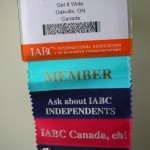
The IABC 2010 World Conference is coming to Toronto June 6-9, and if you’ve ever been to one, you know that everyone wears these honking big badges. They aren’t just nametags; they have stick-on ribbons that identify you as an IABC member, a speaker, a Gold Quill winner, and so on. There are ribbons promoting the next conference location and date, and sometimes a chapter will produce something special, like Toronto’s “Large chapter of the year.” My all-time favourite is “IABC  Canada, eh!

This year, IABC/Toronto’s independents — known as Professional Independent Communicators — are producing our own ribbon. Actually, it’s not just for those of us in Toronto; our intent is that any independent at the conference can and should have one. And we’d also like to share a ribbon with those who know and appreciate independents as the amazing resource we are. In either case, we’d like to start up a conversation.

So if you’re an indie coming to the party, er, IABC 2010 World Conference, watch for someone wearing an “Ask about IABC INDEPENDENTS” ribbon. And if it’s me, ask me for a ribbon, too!

Are you coming to the IABC party?

March 24th, 2010

Woo hoo! Toronto is getting ready. Some 1,400 of our dearest communicator friends from 40 countries are coming to our backyard for the 2010 IABC World Conference June 6-9. And it’s going to be one heckuva barbecue!

Well, OK, it’s not going to be a barbecue, but it’s going to be fun — and yes, a tremendous learning, growing and networking good time. And shopping. (More on that later.) Visitors will have a chance to go on walking tours of the hip and historic Distillery District, anchored by the old Gooderham & Worts distillery constructed in 1859, and Casa Loma, a medieval-style castle in the middle of the city. We’re going to the Royal Ontario Museum for the opening reception, checking out the love-it-or-hate-it Michael Lee-Chin Crystal addition that opened in June 2007.

As always, there’s a stellar lineup of content, including high-profile speakers like Guy Kawasaki and Craig and Marc Kielburger, and IABC luminaries like Steve Crescenzo, Shel Holtz, Les Potter and Ron Shewchuk (sorry, I’m leaving off all your ABCs and other designations). My own more local friends and colleagues Jan Graves, Linda Johannesson, Cyrus Mavalwala and Donna Papacosta are also speaking.

I’ll be there! As an independent, I need to regularly update my knowledge and skills, and the conference is a great place for that. It’s also important to pull myself out of my home office once in a while and see and be seen; again, the conference is great for that. What I’m also looking forward to is something I found happened at the 2009 conference in San Francisco: meeting or renewing friendships with communicators I’ve met online. This year, I’m making an extra effort to meet up with other independents, so please let me know if that’s you, and let’s talk about how we’ll find each other amid the crowd of 1,400 or so.

Oh, yes, about the shopping. I’ve found at past conferences that attendees end up trying to dash out at lunchtime or between sessions to grab a souvenir of the city, find a new pair of jeans or indulge that passion for new shoes. If that’s you, you’ll be glad to know that your Toronto pals are putting together a quick guide to the “don’t miss” places to shop, whether you have an afternoon or just an hour. I’d love to hear what you’re looking for, or if you’re a local, where you think the hidden gems and great shopping spots can be found.

Are you coming to Toronto? If you’re already here, are you going?

We heart Best Buy CEO

August 19th, 2009

Best Buy CEO Brian Dunn had the communicators at the IABC conference in San Francisco in June in the palm of his hand, as I mentioned talking about highlights of the conference. He seals the deal with this interview in the The New York Times published August 15. If you haven’t seen it yet, go read it!

One of the comments that captures his down-to-earth personality:

“You’re never as good as they say or as bad as they say. When I was made CEO on June 24, I didn’t wake up that morning smarter. I didn’t wake up with a massive I.Q. expansion.”

I particularly love how he weaves stories into his conversation:

“Let me tell you a quick story that I think will illustrate it the best…” (and it does)

and the enthusiasm he displays:

“I love my gadgets and I’ve got to tell you why.”

which launches into a heartwarming story about virtually watching a basketball game with his sons, which ends:

“The only thing I can’t do is put my arm around them.”

As I said at the conference, he pretty much had us at hello!

More SF highlights

June 21st, 2009

The 2009 IABC World Conference in San Francisco was a whirlwind of learning opportunities and social events. (Great promotional clip for it here.) Here are some of the highlights:

  • Brian Dunn, COO and soon to be CEO of Best Buy: Down-to-earth, personable, enthusiastic, this year’s EXCEL award winner had many communicators in the audience wishing they worked for/with this man. He used humour and plenty of examples of the cool things Best Buy is doing to reach their Gen Y employees.
  • Robert Swan, OBE: The first man to walk across both the South and North Poles, raising awareness and taking action to save Antarctica. Also plenty of humour and great visuals, although after seeing the almost destroyed heel, I apologize for ever complaining about the tiny blisters I got walking half an hour from the opening reception to the Canada party. Here’s a brief summary of his inspiring message about sustainable leadership.
  • Of course the opening reception at the Ferry Building, followed by the CNW Group-sponsored Canada party. We Canucks have a reputation to uphold (throwing great parties at the IABC conference), and I’m proud to say we did it.
  • The Tuesday evening dinearound is always a fun opportunity to meet new people and get to a restaurant recommended by a local IABC member. I signed up early online, choosing a “North Beach experience” that included dinner at a great Italian restaurant, stops in pastry and candy shops and the City Lights bookstore and a pleasant walk back to the hotel (me in sensible running shoes). My dining companions and I have since connected on LinkedIn. Thanks, Mary!
  • I found the session on communicating with Gen Y interesting. Presenters Leah Reynolds and Anna Whitlow said Gen Y is a “catalyst for change” in the workplace. Something that struck me was the comment that we all want work/life balance; for Boomers, it may be more time with children, while for Gen Y, it may be a sabbatical to volunteer in another part of the world. Another comment: We should ask our Gen Y employees how they want to be communicated with.
  • Angela Sinickas had excellent points to make about measuring communications, including asking the key question, “What do you want people to do differently as a result of your communication?” She commented that the cascading method of communicating (often used in the corporate world, where the top dog shares info with the VPs, who are supposed to share with directors, and on down the chain) is actually the biggest way to feed the rumour mill. She also had good advice on figuring out return on investment and finding low-cost ways to measure. See her top tip here.
  • An interesting talk by BJ Fogg on Design for behavior change: Why Facebook and Twitter are winning. He called Facebook the number one persuasive tool, where even a novice without any particular skill can reach 24 million people. “Big brains probably over-think” campaigns, he suggested, showing a quick “eat a veggie” video he created as an example of simplicity. He said the people you are targeting with your campaigns must have motivation and ability to do what you’re asking, and the often missing piece is a trigger, the “do this now” factor. Look how easily people signed up for Facebook and Twitter, or how you willingly give companies your e-mail address.
  • I always go to a session on writing, since that’s how I spend my days, for inspiration. Again, a conflict, but I chose Ann Wylie on Writing to sell. Some of her advice: Make it relevant to the reader. “More gain, less pain.” Lead with the benefit, support with the feature/advantage. (“Look better naked with David’s Gym.”) Check your focus and how much you are talking about “you” vs. the reader using tag clouds (e.g. TagCrowd and Wordle). Nudge the information closer to the reader. (Not “Death rate drops” but “We’re living longer.”) If the information is irrelevant to the reader, why are you bothering? You want to train people that every message from you is useful and relevant.
  • Building relationships that were started online, as I mentioned in my last post.

Unfortunately, I missed plenty. At least, as an IABC member, I could go online and download some of the presentations, and I’ve been able to find a few recaps on YouTube or individual blogs:

  • I arrived at the conference hotel on Sunday in time to catch just the last 10 minutes or so of Les Potter on Strategic communication planning & management: Fundamentals for success. I already have an electronic version of his The Communications Plan: The Heart of Strategic Communication, but wanted to hear him in person and introduce myself, if there was a chance. Les and I have what I think of as a cosmic connection, having both started our blogs about the same time. (Originally, I thought it was the same DAY, which would have been really cosmic; turns out the date stamp was from the last comment on the first post.) We met, and next day we shared a delightful chat over a latte (thanks again, Les!).
  • Having “all-star” sessions is a great idea, but that means picking just one among a variety of terrific speakers. Even among mainstream sessions, I found several times two sessions I wanted to attend took place at the same time. Thus I was sorry to miss Shel Holtz’s The news release in the social media era (although I listened to his podcast of the session after I got home); Lee Hopkins on 3D virtual worlds (again, found later); Neville Hobson on podcasting (his one-minute summary here); and others.
  • I was on my way to the airport when the closing keynote speaker — Sir Ken Robinson on Finding your passion — apparently blew everyone away. Here’s the poor absentee communicator’s substitute.

Other things I learned:

  • Remember to bring lots of business cards. If you’re doing it properly, you’re meeting new people and exchanging cards.
  • Keep your own business cards tucked into your conference badge so they’re always handy, and then your pocket is available for the cards you get.
  • If, like me, you work in a home office and are more likely to be barefoot or in running shoes than high heels, bring bandaids to cover the inevitable blisters.
  • It will seem like a good idea at the time at the Canada party, but don’t put your Canadian flag tattoos on your face or your cleavage. (Thanks for asking, but mine was on my arm, and it took a lot of scrubbing to get it off.)
  • Take the time to sightsee. I arrived early with my husband to see some of this wonderful city. We spent one night in the city sightseeing, then two nights in Sonoma with my brother and almost-sister-in-law. Toured wine country and visited Artesa, Silver Oak, Provenance, Rutherford and Sterling Vineyards. We dined at some lovely restaurants, and did the real touristy stuff like having a bowl of chowder at Fisherman’s Wharf and Irish coffee and eggs Benedict at the Buena Vista Cafe, watched bakers making bread at Boudin at the Wharf (love the alligator loaves) and saw the sea lions camped out like a pile of puppies in Pier 39’s West Marina.

Were you at the conference? What sessions stood out for you? What ‘don’t miss’ sights did you see?

P.S.  I mentioned in my last post rooming with communications/podcasting ‘rock star’ Donna Papacosta, and that was another highlight I should have included in this list. Donna is a great writer and friend, and you should check out her list of highlights, too!

Sue’s excellent SF adventure

June 17th, 2009

Back from the 2009 IABC conference in San Francisco (it’s a week ago already!) and I’ve finally found a few minutes to blog about it. (If you’re visiting from Les Potter’s blog, welcome! Be warned you’ve arrived at the PotterHorn mutual admiration society.)

I’ve blogged before about the value of attending IABC conferences, and I’ve been to many over the years. The professional development is great, the people are warm and welcoming, the social events are terrific (including the traditional hospitality of the Canadian party, sponsored for the second year in a row by CNW Group) and you can usually fit in some sightseeing in fun cities. Everyone has a large badge, so when you encounter in the halls and elevators, it’s your invitation to start a conversation. And that’s the thing with communicators; we barely need an invitation to get started talking.

That was definitely the case this year, but there was also something different happening: More than ever the conference built and cemented relationships that got their start online.

Say what you like about the time it takes to properly use Twitter, Facebook, blogging and other online adventures, it turns out the time can actually be well spent.

This is probably the first time I knew ahead of time that several people were attending, and made plans (that actually came through) to meet. The “warm” connections made by learning snippets of information on Facebook and Twitter and sharing comments on blogs and e-mails all led to a welcome feeling of familiarity with people I had only met online. So when we did meet in person, it was like meeting up with old friends. As Les described it, it was “a continuum of friendship not affected by time or space.”

So I had a delightful chat over coffee with Les. I got a warm hug from Linda Johannesson, with whom I’ve corresponded for years. I reconnected with a friend from Calgary I met at the dinearound in New York last year. I enjoyed getting to know fellow Toronto chapter members over dinner and on the walk from the opening reception to the Canada party. I briefly met some of the “rock stars” of communications, like Les, Steve Crescenzo, Shel Holtz and Lee Hopkins. I roomed with another rock star, podcasting queen Donna Papacosta (although we’ve known each other for at least 10 years).

Oh, and since I’ve been back, the people I met at this year’s dinearound have been in touch and we’re now connected on LinkedIn. Since the IABC conference is in Toronto next year, I’ve asked them to let me know if they’re going to attend and we’ll keep the connection going.

So the social piece of this year’s conference was a big highlight. More later on what I learned in the sessions.

Splitting hairs

August 10th, 2008

So IABC has renamed their annual international conference. It’s now going to be called the “world conference,” to “better reflect the organization’s global reach and mission.”

Um, sounds like pretty much the same thing to me.