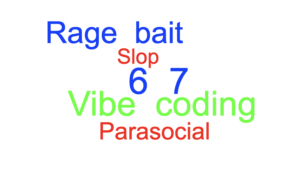
 Before 2025 was even over, people were talking about the Words of the Year. These represent the topics people searched for online, that caught the public’s imagination, showed widespread use or reflected important events, people and preoccupations.
I waited until votes were in from a couple of places that choose in January. Drum roll! Here are the words that earned spots on Word of the Year lists for 2025:
6-7: Dictionary.com
Pronounced “six-seven,” this slang term is “meaningless, ubiquitous and nonsensical,” says the dictionary. It can be traced back to a song called “Doot Doot (6 7)” by Skrilla. Other words on the short list include aura farming (intentionally developing one’s presence); broligarchy (a concentration of power among a small group of high-profile tech and business leaders); and kiss cam (like the one that captured the image of two executives canoodling at a Coldplay concert. I was disappointed that “Coldplayed” did not make the list!).
The public also voted 6-7 as the top word on the 2026 list of “misused and overused words that should be banished” posted by Lake Superior State University in Michigan. The list also included demure (used by a TikToker in the phrase “very demure, very mindful”); incentivize (an unfortunate instance of turning a noun into a verb); and my bad (which hardly conveys an apology).
Parasocial: Cambridge Dictionary
Parasocial is the word for the connection fans feel between themselves and a famous person they do not know or a character in a book, film, or TV series they binge-watched. By September 2025, the Cambridge Dictionary updated the definition of parasocial to include the possibility of a relationship with an artificial intelligence.
Rage bait: Oxford University Press and Oxford Dictionaries
Rage bait is online content designed to cause anger or outrage by being frustrating, provocative or offensive, with the aim of driving traffic to a particular social media account. The shortlist also included aura farming (presenting yourself with an air of confidence, coolness or mystique) and biohack (trying to improve your physical or mental performance, health or longevity by altering your diet, exercise routine, lifestyle or drugs).
Slop: American Dialect Society, Merriam-Webster, and Ragan Communications
Perhaps reflecting how artificial intelligence is everywhere these days, slop made the top of numerous charts. American Dialect Society defined slop as low-quality, high-quantity content, typically produced by generative AI. Merriam-Webster agreed, although was quick to point out that humans chose it as the Word of the Year. Ragan added that slop is “material designed to keep eyes moving without giving the mind something meaningful to hold.”
Other words often looked up were gerrymander (dividing districts to give one political party or group an unfair advantage), touch grass (participate in normal activities in the real world vs. mindless online scrolling); performative (made or done for show); and tariff (a schedule of duties imposed by a government on imported goods).
Vibe coding: Collins English Dictionary
This word describes how AI enables creative output while you can forget that the computer code behind it even exists. Other shortlisted words are aura farming, biohacking, broligarchy (see above), taskmasking (giving a false impression that you’re being productive at work), micro-retirement (a break between periods of employment to pursue personal interests) and glaze (the praise or flatter someone excessively or undeservedly).
Did you look up or use any of these words? Which ones do you find most annoying?
Related reading:
Dissonance and polarization lead in 2024
AI and hallucinate top the 2023 Words of the Year
Gaslighting and goblin mode lead the 2022 list
Pandemic words still dominated 2021