
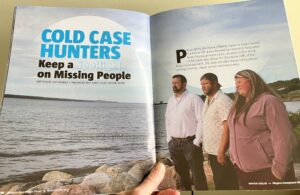
 A cold case is more than a crime drama on TV, where long-unsolved investigations are reopened. In Ontario’s Niagara Escarpment area, a non-profit group called Please Bring Me Home is working to solve cold cases close to home. My article in the Winter 2025-2026 issue of Niagara Escarpment Views magazine looks into how and why this group came to be and how they operate.
Cold Case Hunters Keep a Spotlight on Missing People
Lisa Maas had been missing for two years when Matthew Nopper heard about her disappearance. A former reporter, Matthew was fascinated by missing persons cases, and this was close to home. Lisa hadn’t been seen since leaving a party near Owen Sound in July 1988. Recently moved to the area, Matthew joined a search for her.
It was one of many civilian and police searches for the 22-year-old, including OPP officers rappelling into a chasm at the top of the Niagara Escarpment. All searches came up empty.
Although the searches petered out over the years, the case stayed with Matthew. After his own father disappeared in 2012, the body found by police after a search, Matthew felt compelled to help others.
In 2013, Nick Oldrieve moved to Owen Sound. At the time, he was part of a crisis team helping locate missing youth in foster care. He heard about Lisa’s case and began looking into it in his spare time.
Melissa Harwood had a passion for crime research and reached out after hearing about Nick’s efforts. So did Matthew. The three realized they shared a passion: to bring home those who were missing.
From Idea to Action
Lisa’s case inspired Matthew, Nick and Melissa to launch Please Bring Me Home. The not-for-profit organization maintains an anonymous tip line and social media accounts with the intent of looking at local cold case files. Nick is executive director; Matthew is in charge of media; and Melissa leads research and trends in missing persons cases.
The name represents the plea of a missing person. “Our goal is to find the missing and bring them home to their family and friends,” Matthew says.
At the time, there were at least seven missing person cases in the area. Nick remembers they wondered, “What if we could help find a missing person and prevent them from turning into a decades-old cold case?”
The team did just that in 2018.
Nolan Panchyshyn had gone missing in mid-December 2017. After almost two months with no answers, the family asked PBMH for help. An anonymous tip, promptly passed along, helped the local police locate Nolan’s body and arrest two men for his murder.
Five months later, PBMH found the body of Terry Schope. He had been known to walk along Owen Sound Bay, and the team guessed he had simply fallen into the water. Kayaking in the bay and searching with binoculars, they spotted clothing almost exactly where tides suggested a body might wash up.
Perils Require Planning
Many searches take place in Escarpment country, which means careful planning. Even in July, you might find snow and ice in deep fissures. Almost every search shows evidence of bear activity, and the area includes thick forest and difficult trails.
“In some places, you’re so deep in woods, you wonder if any human has ever walked where you are,” Nick says.
Partnering With Police
PBMH members are careful not to step on law enforcement toes or contaminate a case.
“When we started, the OPP weren’t shy about letting us know we were a pain,” Nick says. “But I think we’re now appreciated more than seen as a hindrance.”
The team recognizes that police often lack the resources to devote to cold cases, and new investigations take priority. Also, the team believes that in cold cases, some people just don’t want to talk to police. “We’re often a last-ditch effort to bring cold cases to a conclusion,” Nick says.
The team also takes police feedback to heart. Told they shouldn’t be interviewing the public because they were untrained, they lined up instruction. Told they didn’t have the training to conduct searches, they now work with a retired OPP officer specializing in ground search and rescue. They also partner with specialists in canine search and an anthropologist who looks at bone fragments.
PBMH relies on the generosity of businesses and individuals to cover expenses such as equipment, mileage and food for experts and volunteers. All team members have day jobs and donate their own time and resources, and local companies often sponsor excavators.
W5 Spreads the Word
In 2019, CTV’s W5 aired a documentary about Please Bring Me Home and its work to find missing people. Almost immediately, the plan to stay local changed.
“We received an influx of requests from family members in every province,” says Nick. They couldn’t say no. Now they keep missing persons from across Canada in the public eye — but only if asked by a family member.
At a minimum, the missing person information goes on the website and social media. The team follows an intake process and begins a formal investigation, speaking with family, friends and others. “We’re all after the same thing, to help close this loop of not knowing that can eat you alive,” says Matthew.
There are thousands of cold cases out there, and PBMH is actively following about 107. Sometimes the cases have been cold for years or decades; other times the person disappeared just weeks before.
When they do close cases — and they’ve contributed to wrapping up close to 70 as of May 2025 — it’s always due to one or more of three factors: an anonymous tip; an investigation; a search.
“It never ceases to amaze me how a simple post about a missing person can bring in significant information,” Nick says. “I can’t help but wonder what cases might have been solved if these platforms were around decades ago.”
Lisa’s parents never discovered the truth about their daughter’s whereabouts before they passed away, her mother in 2019 and father in 2024. But they never lost hope that someone would find her, and PBMH hasn’t either. They still conduct a yearly search.
If you have a tip about a missing person, contact your local police, OPP, RCMP or Crime Stoppers. You can also leave an anonymous tip with Please Bring Me Home at pleasebringmehome.com, or its tip hotline at 226-702-2728. If you need help finding someone, fill out the intake form online.
Also in Niagara Escarpment Views magazine:
All’s well that end-to-ends well
Road ecology steps in where animal instincts and urban sprawl collide
Community garden movement growing like a weed
Antiquing is a treasure hunt through time