
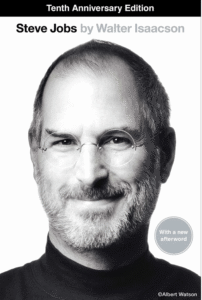
 If you’re a fan of Apple products, as I am, you no doubt have thoughts about founder Steve Jobs. I recently finished reading Steve’s biography by Walter Isaacson, a thoroughly researched account of the career and life of a complex, imperfect person who was both brilliant and apparently sometimes a jerk.
One of his memorable talents was using analogies to help understanding. As he described it, “Analogies work because they make the unfamiliar familiar; they help the mind navigate new terrain by making it resemble terrain we already know.”
One that stands out for me was when he introduced the iPod (RIP!) by saying it would let you take your whole music library with you in your pocket. And it did!
Analogies can be similes, which use “like” or “as” to show how two things are alike. Or analogies can be metaphors, which suggest a likeness without those words. Here are some examples.
Similes
“On scans, the minds of people listening to music light up like the pyrotechnics at a Taylor Swift concert.” – David Paterson, urban innovation hub MaRS
“Markets tend to move higher like they’re climbing stairs, and they go down like they’re falling out a window.” – JJ Kinahan, chief executive officer of IG North America
Adding [multifactor authentication] wherever possible is like “having a deadbolt to the door of your digital life.” – Cybersecurity expert Abbas Yazdinejad
“The dense forest’s regrowth could be affected by how deep the fire burned into the ground and how many pine cones hatched like popcorn in the intense heat.” – Associate professor Jen Beverly
Metaphors
On the sudden appearance of European firebugs in Ontario: “’It’s as if one of them sent out a signal, calling the others, like they got an email telling them to attend a Zoom meeting,’ Annie said when I contacted her to learn more about the novel creatures and where she had seen them.” – M. L. Bream in the Toronto Star
“The relentless grind of Toronto traffic congestion…meant that a streetcar on the route would often take over an hour to travel the 2.6 kilometres from Bathurst to Jarvis Street… A determined turtle can travel on land almost twice as fast as those red rockets were going.” – Journalist Edward Keenan
“[Ireland] is a place shaped by proximity to the ocean: nothing stands between the sea and the country’s craggy, cliff-lined shores for roughly 3,000 kilometers, leaving it open to the raw breath of the North Atlantic.” – Claudia Geib in Hakai Magazine
“Redesigning Parkdale as a narrower corridor so that it’s not such an appealing speedway…has long been the obvious fix, but city hall has addressed this speed problem with all the velocity of a tortoise covered in molasses.” – Matt Elliott in the Toronto Star
Where do you find ideas?
Most reporters agree on the building blocks for a good analogy: simplicity, relatability and accuracy, says The Open Notebook.
Former Nieman Storyboard editor Jacqui Banaszynski suggests, “Think about how you would describe it literally so someone else, not able to see it for themselves, would have little doubt about its shape, color, weight, texture, utility, even smell.”
Pay attention when someone is explaining or describing something. Stories about medical or scientific breakthroughs or discoveries almost always have some creative analogies. Create your own by relating things to how they sound, look, taste, smell or feel. How would you explain the inner workings of something to a child, a friend, an alien?
I’d love to hear your own great analogy finds!
Related reading
My fond farewell to the iPod
Expressive writing samples, including one from Steve Jobs
Steve Jobs touched my life; yours too?